


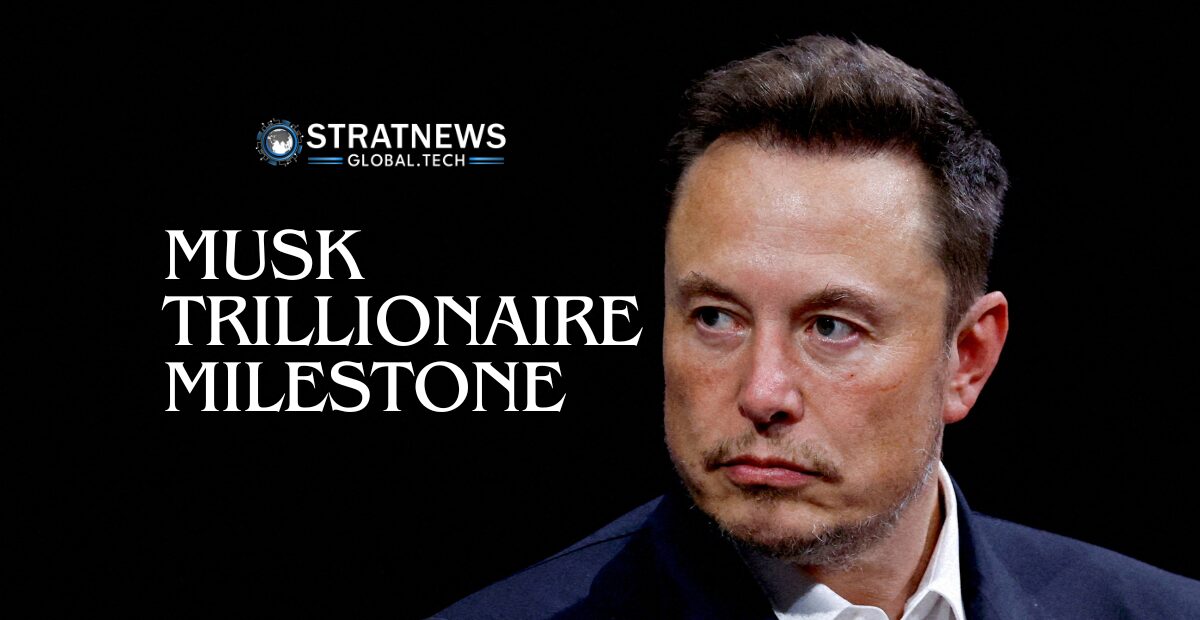
Elon Musk Becomes World’s First Trillionaire As SpaceX IPO Fuels Wealth Surge
Elon Musk has become a trillionaire and one of the most influential business figures of the modern era, building a global profile that extends far beyond the corporate world. As concerns about inequality continue to shape public debate, Musk has remained a uniquely prominent figure, attracting both dedicated supporters and vocal critics.
While admirers praise his direct communication style and ambitious vision, critics have questioned the concentration of power around his businesses, raised governance concerns and criticised his increasingly political public role.
SpaceX IPO Drives Historic Wealth Milestone
Investor confidence in Musk’s business ventures received a major boost when SpaceX, the rocket, satellite and artificial intelligence company at the heart of his empire, raised a record $75 billion in its initial public offering on Thursday.
Before the share sale, Forbes estimated Musk’s net worth at approximately $780 billion. That figure already placed him well ahead of other wealthy individuals, including Alphabet co-founder Larry Page.
According to Matt Durot, deputy editor at Forbes Wealth, the world’s second-richest person has remained near the $300 billion mark, highlighting the scale of Musk’s financial lead.
Most of Musk’s fortune is now linked to his SpaceX holdings, which are valued at roughly $866 billion. When combined with his stake in Tesla and other assets, Forbes and Reuters calculations based on company filings indicate his wealth will exceed $1.1 trillion once SpaceX shares begin trading on Friday.
Building A Business Empire
Musk first gained widespread recognition through Tesla and SpaceX before expanding his influence through the $44 billion acquisition of Twitter in 2022. The purchase gave him direct access to hundreds of millions of users and strengthened his role in public debates on politics, immigration, government spending and free speech.
His involvement in politics became especially controversial through his role in U.S. President Donald Trump’s Department of Government Efficiency. At the same time, Tesla experienced weaker sales across several international markets during 2025 as protests and consumer boycotts targeted the company.
Born in Pretoria, South Africa, to a Canadian mother and a South African father, Musk attended the University of Pennsylvania and graduated in 1997.
He became Tesla’s chief executive in 2008 with the belief that electric vehicles could combine performance with advanced software capabilities. Many industry observers argue that Tesla’s success encouraged traditional carmakers to accelerate their own transition towards electric vehicles.
The Elon Premium
Investors increasingly view Musk’s businesses as long-term bets on his ability to transform industries. However, SpaceX remains heavily dependent on investment, and many of its technologies may require years before reaching full commercial viability.
Beyond Tesla and SpaceX, Musk has co-founded several other companies, including The Boring Company and Neuralink.
Supporters credit him with helping Tesla become the world’s most valuable automaker. Former General Motors vice chairman Bob Lutz said Musk renewed global respect for American automotive engineering.
Nevertheless, Tesla has faced legal disputes and shareholder scrutiny, particularly regarding Musk’s 2018 compensation package.
The influence of Musk’s network of companies has become so extensive that some market observers refer to it as the “Muskonomy”. Investors have also coined the term “Elon premium” to describe valuation gains driven partly by confidence in Musk’s vision rather than conventional financial measures.
Matt Kennedy of Renaissance Capital said SpaceX, like Tesla, represents a bet on Musk himself. He added that valuations between $1.5 trillion and $2 trillion would challenge traditional valuation methods and reflect the strength of the so-called Elon premium.
Influence Beyond Business
The growing concentration of influence around Musk has intensified debate over corporate governance, conflicts of interest and the risks associated with linking company performance closely to one individual.
Over the years, Musk has engaged in highly public disputes with regulators, investors, journalists, media organisations and short sellers, often using social media as the primary battleground.
His relationship with Donald Trump followed a similar trajectory. After supporting Trump’s return to the White House and serving in an advisory capacity through the DOGE initiative, Musk became one of the administration’s closest corporate allies.
The partnership later deteriorated amid disagreements over policy and spending, leading to a public dispute. Although both sides later adopted a more conciliatory tone, the episode highlighted the overlap between Musk’s business interests and political ambitions.
Despite repeated controversies, many investors continue to focus on Musk’s record of transforming ambitious ideas into highly valuable companies. JPMorgan Chase chief executive Jamie Dimon recently praised Musk, describing him as a modern-day innovator. Dimon, who previously clashed with Musk in a lengthy legal dispute, later expressed admiration for the entrepreneur and compared him to some of history’s greatest inventors and thinkers.
With inputs from Reuters

